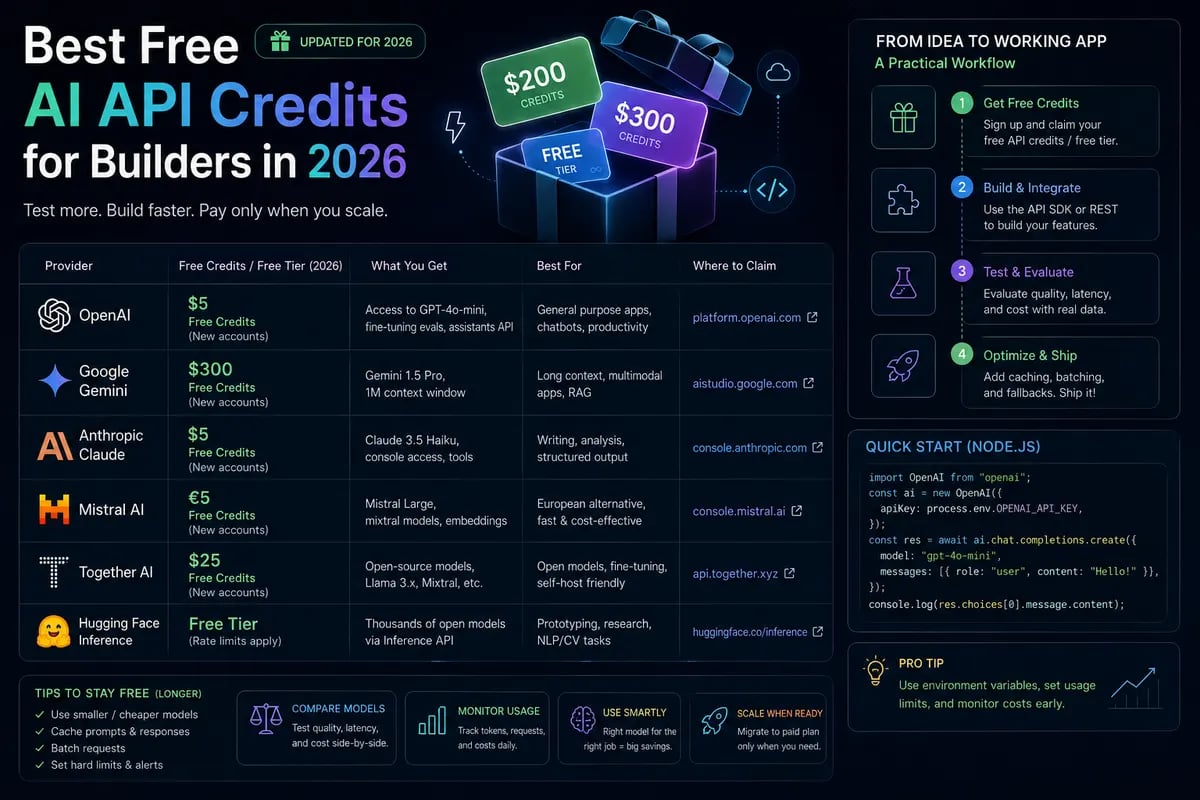
Why free credits still matter
A lot of AI content talks about paid APIs as if every builder already has a budget. That is not reality for most indie hackers. In 2026, the best way to move fast is still to start with a free tier, validate demand, then pay only after the app proves it can hold attention.
The trick is not hunting for the biggest credit number. The real trick is finding a workflow that lets you test prompts, streaming, tool calls, and error handling without burning money on day one.
Who this is for
This is for solo founders, early-stage teams, student builders, and developers who want to ship a proof of concept without opening a billable account first. It also helps if you're building internal tools and just need enough capacity to test the experience.
My opinion: use free credits to validate the product shape, not to fake production scale. Once the app is getting real usage, move quickly to paid APIs so you stop living inside rate limits.
Where builders usually start
In practice, builders look at three buckets:
- Model providers with trial credits.
- API gateways that expose multiple models with a single key.
- Free-tier models that are good enough for prototypes.
Agent-router style gateways and OpenRouter-style access patterns are attractive because they reduce vendor lock-in and let you swap models from one OpenAI-compatible integration. Gemini’s free web tier is often the easiest place to test prompts quickly, while ChatGPT free and Claude free are better for manual experimentation than automated app traffic.
Best free vs paid workflow
Here is the workflow I actually recommend:
- Prototype prompts in the web UI.
- Move the same prompt into your app with a free API key or credits.
- Measure latency, token usage, and failure rate.
- Route only the successful path to a paid model.
That sequence saves time because you do not spend a week building integrations before you know whether us before you know whether users care.
Example setup
are.
Example setup
bash
npm install ai openai zod
ts
import OpenAI from 'openai'
const client = new OpenAI({
apiKey: process.env.OPENAI_API_KEY,
baseURL: process.env.OPENAI_BASE_URL
})
export async function testModel() {
const res = await client.chat.completions.create({
model: 'gpt-5-mini',
messages: [{ role: 'user', content: 'Write one onboarding email' }]
})
return res.choices?.message?.content
}
That same code can often work against OpenAI-compatible gateways by changing only the base URL and key.
What to test first
Don’t test fancy stuff first. Test the boring parts.
- Streaming response stability.
- 429 handling.
- Timeout retries.
- Token usage per request.
- Whether your prompt still works when the user types garbage.
A model with a shiny demo but bad rate-limit behavior will waste more time than it saves.
Free credit sources and practical use
Some services still offer useful starting capacity in 2026, but the details change often. Publicly visible writeups point to free-tier access in Gemini, ChatGPT, Claude, and gateway-style providers that bundle multiple models behind one key
. A few also advertise credit-based onboarding, though those offers can be tied to referral or signup conditions and may change without much warning
.
That means the smart move is to design for portability. If a free credit source disappears, you should be able to swap in another provider without changing your whole app.
How to avoid getting trapped
There are three common traps.
First, people hardcode one vendor into the app and then discover their free tier evaporated before launch. Second, they use expensive models for tasks that only need classification. Third, they do not log token counts, so they cannot see where the money is going.
A tiny logger fixes a lot:
ts
export function logUsage(model: string, inputTokens: number, outputTokens: number) {
console.log({ model, inputTokens, outputTokens, total: inputTokens + outputTokens })
}
Decision table
| Option | Best for | Free tier value | Production risk |
|---|
| Provider web UI | Prompt testing | High | Low relevance to app traffic |
| OpenAI-compatible gateway | Multi-model app prototypes | Medium to high | Depends on provider policy |
| Direct provider API | Real app traffic | Medium | Lowest operational surprise |
| Free-tier model only | Demos and internal tools | High | Rate limits and changes |
Recommended stack
For most builders, I’d use this stack:
- A free web UI for prompt shaping.
- An OpenAI-compatible gateway for API experiments.
- A direct paid API only after usage is real.
That keeps your early costs near zero while preserving a clean path to production.
What breaks first
Free tiers often fail on burst traffic, background jobs, or any feature that needs predictable latency. If your app becomes a habit, you will hit limits faster than you expect. That is not a bug; it is the business model.
So the honest answer is: free credits are for learning and validation, not for pretending you have a scale plan.
Next step
Pick one free provider, one gateway, and one paid fallback. Then test the same prompt on all three and measure cost, latency, and output quality before you commit to a single integration.