Why this pattern is worth shipping
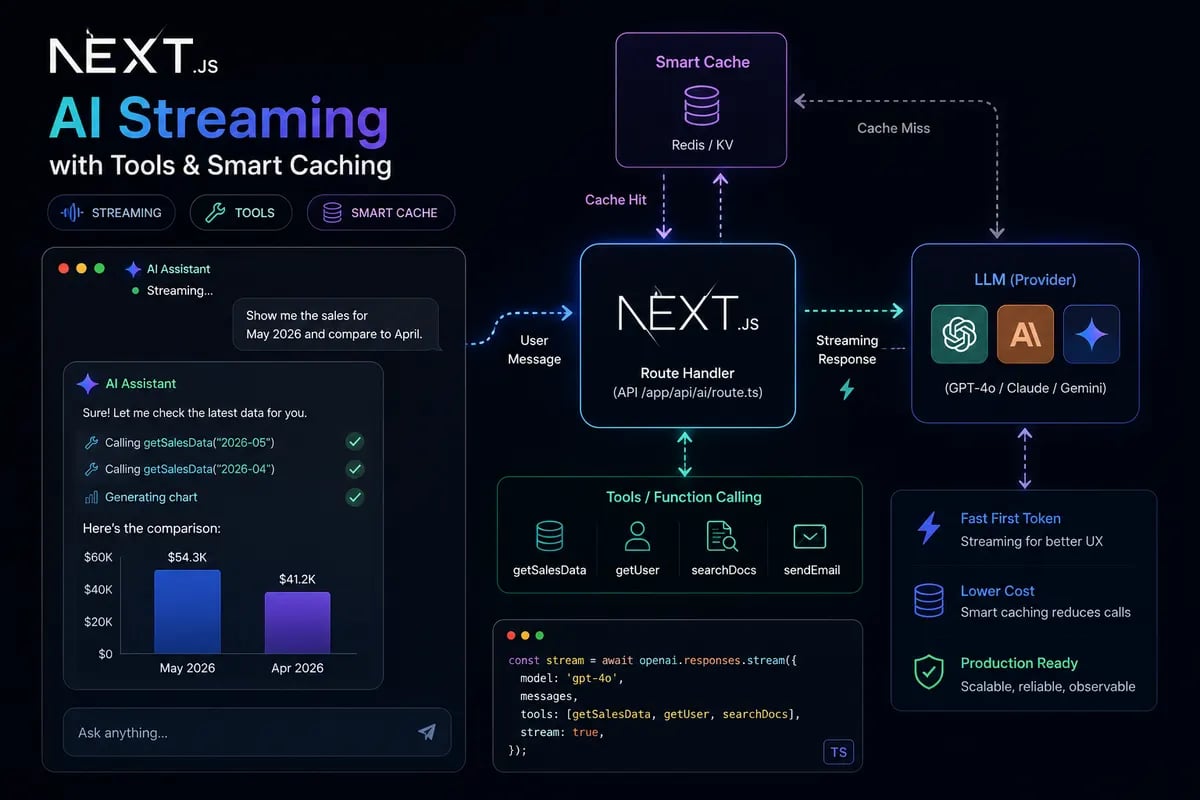
If you are building an AI feature in Next.js in 2026, the fastest path to a usable product is streaming plus a thin tool layer plus caching. That combination gives you good perceived speed, predictable cost, and a clean way to add search or data lookup later.
The reason this matters this week is simple: users are less tolerant of blank screens and slower assistants now. If your app pauses for three seconds before showing the first token, it already feels old.
Who this is for
This is for developers building chat widgets, copilots, internal tools, or AI-powered dashboards in Next.js. It is also useful if you already have an app and want to add AI without creating a messy codebase.
The architecture
The pattern is straightforward:
- Next.js route or server action handles requests.
- Vercel AI SDK streams text back to the client.
- Tool calling fetches live data when needed.
- Cache stores repeated responses.
That is enough for a lot of proda lot of products.
Core route
ore route
ts
import { streamText } from 'ai'
import { openai } from '@ai-sdk/openai'
export async function POST(req: Request) {
const { messages } = await req.json()
return streamText({
model: openai('gpt-5-mini'),
messages,
tools: {
lookupPlan: {
description: 'Fetch current plan details',
parameters: {
type: 'object',
properties: { planId: { type: 'string' } },
required: ['planId']
},
execute: async ({ planId }) => ({ planId, price: '$29' })
}
}
}).toDataStreamResponse()
}
Client side
tsx
'use client'
import { useChat } from '@ai-sdk/react'
export default function Chat() {
const { messages, input, handleInputChange, handleSubmit } = useChat()
return (
<form onSubmit={handleSubmit}>
<input value={input} onChange={handleInputChange} />
<button type="submit">Send</button>
{messages.map(m => <div key={m.id}>{m.content}</div>)}
</form>
)
}
That gives you a usable base fast.
Smart caching
The AI SDK docs in 2026 describe stream-aware caching patterns, including storing generated output and replaying it chunk-by-chunk when a cached response is reused
. That is a better fit for chat UX than blunt whole-page caching.
Use caching for:
- Repeated FAQ answers.
- Stable tool outputs.
- Popular prompt templates.
Do not cache:
- User-specific private data.
- Live operational status.
- Time-sensitive pricing.
Tool use without chaos
Tool calling is where a lot of apps become useful. But if every tool call is allowed to hit external systems without limits, you will get slow responses and weird failure paths.
Keep tools small:
- One tool per job.
- Strict input schema.
- Timeout at the tool boundary.
- Return normalized JSON.
That keeps the model from improvising its own API contract.
Free vs paid setup
For development, cheap or free model access is often enough to validate the experience. For production, you want a model tier that handles tool use reliably and a fallback plan when rate limits kick in
.
I’d use a cheaper model for drafting and a stronger one only when the tool path or query gets complex. That split is usually the sweet spot.
What usually breaks
Three things break first.
First, the model returns too much text and your UI becomes sluggish. Second, the tool response is too loose and the model misreads it. Third, you forget to cache repeated requests and end up paying for the same answer over and over.
Those are engineering problems, not model problems.
Recommendation matrix
| Scenario | Best approach | Why |
|---|
| Simple chat | Streaming only | Lowest complexity |
| Product assistant | Streaming + one tool | Useful and maintainable |
| Repeated FAQs | Streaming + cache | Fast and cheap |
| Data-backed copilot | Streaming + tools + fallback | Best balance |
Final take
Next.js AI features work best when you keep the system small and explicit. Stream the first tokens fast, call tools only when needed, and cache anything that repeats. That gives users speed without forcing your budget to absorb every question at full price.
If I were starting today, I would ship this pattern before touching agents, multi-step planners, or any fancy orchestration layer.