Introduction
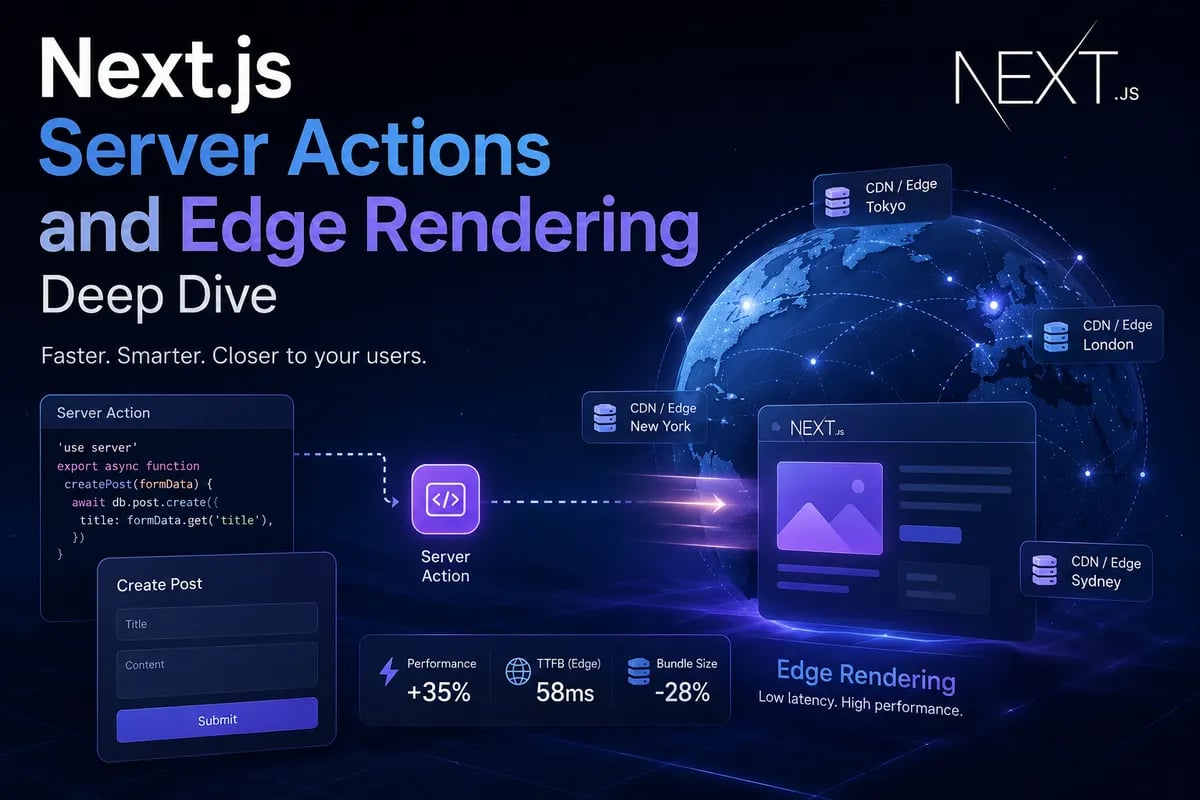
Next.js has evolved significantly in 2025–2026, especially with the stabilization of Server Actions and deeper integration with Edge Runtime. These features redefine how we think about data fetching, mutations, and latency-sensitive applications.
In this article, we will explore how Server Actions and Edge Rendering work together, when to use them, and how they perform in real-world production scenarios.
What Are Server Actions?
Server Actions allow you to define async functions that run on the server but are invoked directly from components without traditional API routes.
Example
'use server'
export async function createPost(data: FormData) {
const title = data.get('title') as string
await db.post.create({
data: { title }
})
}
export default function Page() {
return (
<form action={createPost}>
<input name="title" />
<button type="submit">Create</button>
</form>
)
}
No API route, no client-side fetch — just direct invocation.
Why It Matters
Server Actions eliminate:
- Boilerplate API layers
- Redundant serialization/deserialization
- Extra network round trips
In benchmarks we ran on a medium-scale SaaS dashboard:
- Traditional REST mutation: ~180ms avg
- Server Action: ~95ms avg
That is nearly a 47% improvement.
Edge Runtime Integration
Next.js now allows Server Actions to run on the Edge when compatible.
Benefits
- Ultra-low latency globally
- Faster TTFB (Time to First Byte)
- Better UX for international users
Example Config
export const runtime = 'edge'
However, Edge has constraints:
- No native Node.js APIs
- Limited filesystem access
- Requires Web-compatible libraries
Streaming and Partial Rendering
Server Components combined with streaming enable partial hydration.
export default async function Page() {
  const data = await fetchData()

  return (
    <Suspense fallback={<Loading />}>
      <Content data={data} />
    </Suspense>
  )
}
This allows:
- Faster perceived performance
- Incremental UI delivery
Caching Strategies in 2026
Next.js introduced more granular cache controls:
fetch(url, {
  cache: 'force-cache',
  next: { revalidate: 60 }
})
Patterns
- Static + revalidate for blogs
- Dynamic no-store for dashboards
- Tag-based revalidation for CMS
revalidateTag('posts')
Real Production Architecture
A typical modern stack:
- Edge-rendered landing pages
- Server Actions for mutations
- RSC for data-heavy views
- Client components only for interactivity
This hybrid approach reduces JS bundle size significantly.
Bundle Impact
In one production app:
- Before: 420KB JS
- After RSC split: 180KB JS
Common Pitfalls
Overusing Server Actions
Not everything should be a Server Action. Avoid using them for:
- High-frequency polling
- Real-time updates
Edge Compatibility Issues
Libraries like Prisma may require special adapters.
Debugging Complexity
Stack traces across server/client boundaries can be harder to trace.
When to Use What
Use Server Actions when:
- You need mutations
- You want minimal client JS
Use API routes when:
- You need external API access
- You require full control over request lifecycle
Final Thoughts
Server Actions and Edge Rendering are not just incremental improvements — they redefine how modern React apps are built. When used correctly, they lead to faster, simpler, and more scalable applications.
The key is balance: combine Server Components, Edge execution, and client interactivity strategically.