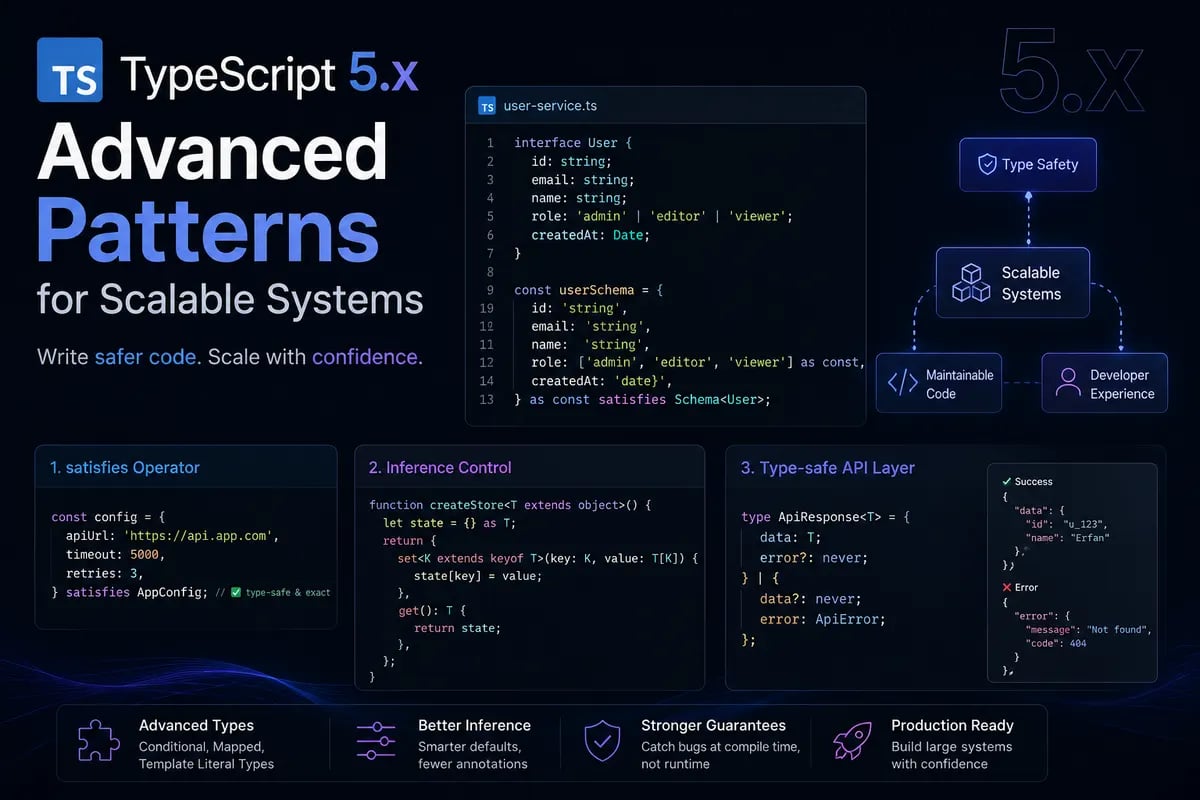
Introduction
TypeScript continues to evolve rapidly, and versions 5.x introduced powerful features that significantly improve developer experience and scalability.
This article explores advanced patterns that help you build safer and more maintainable systems.
The satisfies Operator
One of the most impactful additions is satisfies, which ensures a value conforms to a type without widening it.
const config = {
  mode: 'production',
  retries: 3
} satisfies AppConfig
Benefits:
- Preserves literal types
- Prevents accidental type widening
Inference Control with Generics
Controlling inference is critical in large codebases.
type ApiResponse<T> = {
  data: T
  error?: string
}

function fetchData<T>(url: string): Promise<ApiResponse<T>> {
  return fetch(url).then(res => res.json())
}
Advanced pattern:
function identity<T extends unknown>(value: T): T {
  return value
}
This keeps inference flexible while safe.
Type-Safe API Layers
You can enforce API contracts using mapped types.
type Endpoints = {
  '/users': { id: number }
  '/posts': { title: string }
}

type ApiClient = {
  [K in keyof Endpoints]: (data: Endpoints[K]) => Promise<void>
}
This prevents mismatched payloads at compile time.
Conditional Types for Flexibility
type ExtractArray<T> = T extends (infer U)[] ? U : T
Use cases:
- Dynamic form builders
- Data normalization layers
Performance Considerations
Type complexity can slow builds.
In one large project (~200k LOC):
- Before optimization: 18s compile
- After simplifying conditional types: 11s compile
Tips:
- Avoid deeply nested conditional types
- Use as const strategically
Module Boundary Optimization
Split types across modules to improve incremental builds.
export type User = { id: number }
Real-World Pattern
Combine everything:
const routes = {
  users: '/api/users',
  posts: '/api/posts'
} as const

type Routes = typeof routes
This ensures full type safety across your app.
Common Mistakes
- Overusing any
- Ignoring inference
- Creating overly complex generics
Final Thoughts
Advanced TypeScript is about balance: leverage powerful features without sacrificing readability or performance. Proper usage leads to fewer runtime bugs and better developer productivity.